When offerings are similar, the difference rarely comes down to "an extra dish" or "nicer decor." It hinges on an F&B proposition designed as a true strategy: a clear identity, a memorable experience, and a commercial mechanism that attracts, retains, and encourages consumption.
Everywhere, the same questions arise: how do you establish a place? how do you make it desirable? how do you create repeat business? And above all: how do you transform a simple food outlet into a destination?
A strong F&B offering is one of the few levers capable of generating both marketing value (image, attractiveness, virality) and economic (time spent, average spend, additional revenue), while strengthening a project's overall coherence.
Developing a strong F&B concept has become a strategic lever for operators.
Food service is no longer just "a service." It's a component of the overall experience, just like architecture, programming, or the customer journey.
The upscale trend in many venues, the densification of offerings, and evolving expectations have changed the game: The public wants clear, distinctive, consistent concepts with a real promise.
One observation: we go out for what we can't experience at home
Two types of experiences continue to draw people out: dining and entertainment.
Even if you can order in, cook, or watch a series, nothing fully replaces the atmosphere, social interaction, and energy of a place.
F&B then becomes a universal entry point: it brings people together, provides comfort, creates desire, and builds a habit.
The F&B offering influences foot traffic, not just satisfaction
A strong F&B concept doesn't just work "after" the customer arrives. It works "before," at the moment people choose where to go. It's a promise that spreads (word-of-mouth, social media, Google, recommendations) and triggers the visit.
The 3 objectives of a high-performing F&B concept
A solid F&B proposition must fulfill three functions. It's a simple framework, but remarkably effective.
Attract visitors: become a destination
A “functional” place relies on its natural flow (passers-by, occupants, tourists). A “desirable” place intentionally attracts. Your F&B offering must be able to answer this question: why would someone go out of their way to come here?
Encourage longer stays: increase time spent
The longer people stay, the more the experience takes hold, and the more natural spending becomes. A strong F&B concept can transform a brief visit into a moment : a terrace that invites a stop, a coffee spot that encourages work, a bar that marks the end-of-day transition, a table that makes you want to linger.
Boost consumption: increase value effortlessly
Performance isn't about “pushing”. It comes from fluidity: a clear offering, a simple journey, signature products, consistent quality, coherent pricing. Customers consume more when they understand the promise and have confidence.
8 steps to develop an F&B concept that stands out
Here is a structured method, applicable to any project, from independent venues to real estate developments, from food courts to premium concepts.
Step 1: Start with the real-world context (market + foot traffic + usage patterns)
Before discussing the "concept," it's essential to understand:
- Who are the customers (local, destination, captive, mixed)?
- What are the consumption patterns (morning, lunch, after-work, dinner, weekend)?
- Who are the competitors (direct and indirect)?
- What are the operational constraints (space, ventilation, hours, accessibility, seasonality)?
Without this assessment, we often create an "interesting" venue that is poorly aligned with real usage patterns. Setting up a venue can be challenging, but it's made much smoother with the assistance of an F&B consultancy, such as Tomorrow Food.
Step 2: Define a unique promise that can be articulated in a single sentence
A strong promise is short, specific, and differentiating. It doesn't describe a menu; it describes an intention.
Examples (adapt as needed, the goal is clarity):
- “The Mediterranean sharing table, festive in the evening, generous at lunchtime”
- “The neighborhood coffee & bakery, product-focused, fast, and consistent”
- “The cocktail and small plates bar, focused on music and lighting”
If you can't say it in one sentence, the public won't be able to understand it in 5 seconds.
Step 3: Choose a role within the venue's ecosystem
F&B can be a driver of attractiveness (it draws people in), a service for a community (it builds loyalty), a positioning marker (it builds credibility), and a revenue generator (it optimizes square footage).
Of course, a concept can combine several roles, but you need to prioritize. Otherwise, you end up being 'average everywhere'.
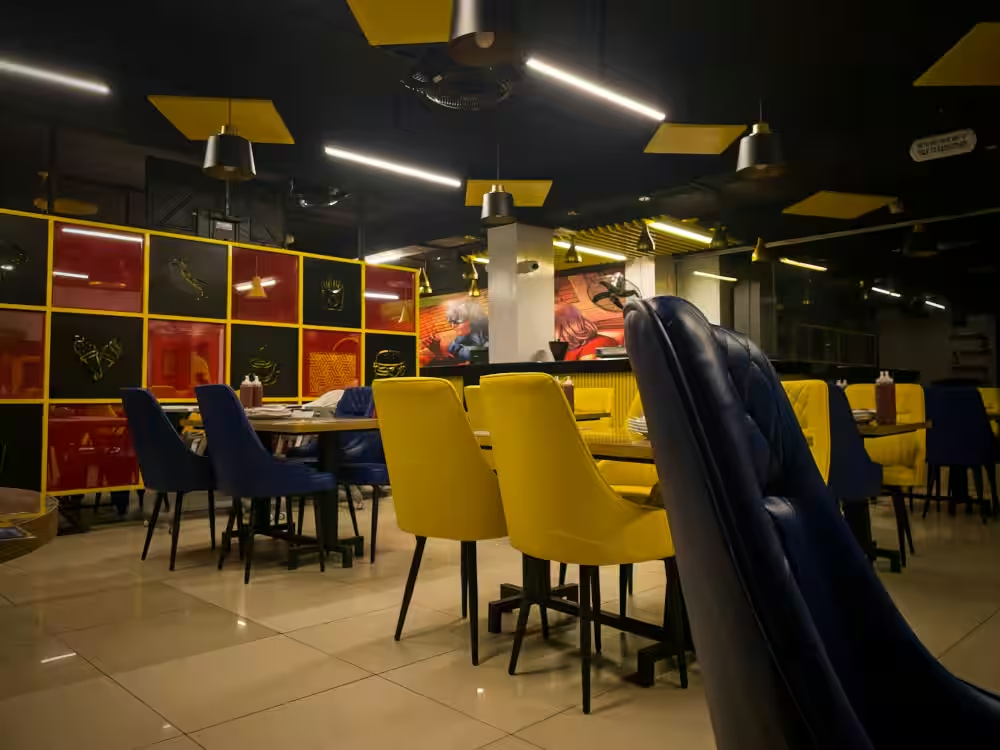
Step 4: Build the complete experience (not just the plate)
The experience is the sum of consistent details:
- Atmosphere (lighting, acoustics, music, density)
- Storytelling (what the place communicates)
- Service (pace, etiquette, warmth)
- Rituals (signature welcome, dessert, cocktail, presentation, "moment")
What is shared is not just "a dish," but a scene: a lively counter, a flame, a gesture, a playlist, a view, a simple activity.
Step 5: Design a daily offering structure
Many projects lose money due to "gaps" in occupancy. A strong F&B offering is conceived in sequences:
- Morning: "reason to visit" (desirable breakfast or signature coffee)
- Lunch: efficient offering (quick but high-quality, clear)
- Afternoon: gentle occasion (snack, coffee, meeting)
- Evening: highlight moment (bar, restaurant, atmosphere, light event)
We aim to maximize space utilization without compromising its core promise.
Step 6: Align menu, pricing, and margin with the promise
The concept must be profitable in real life, not just appealing on a mood board.
- A concise menu performs better than an encyclopedic one.
- Signature products create memorability.
- Consistent pricing builds trust.
- Well-thought-out menu engineering secures profit margins.
Differentiation stems as much from consistency as from creativity.
Step 7: Consider operations from the design phase
Even the best concept will fail if operations aren't managed effectively, from staffing to supplier selection. It's essential to establish simple, reproducible processes, build a stable quality foundation, and anticipate potential technical constraints.
This is often where the difference lies between a “beautiful” place and a place “that works”.
Step 8: launch, measure, adjust without diluting the DNA
Once open, the following KPIs are used to guide operations:
- Traffic, conversion rate (visitors → customers)
- Repeat customer rate
- Average basket by time of day
- Leading products and underperforming products
- Wait time and friction
We adjust while keeping the promise intact: we optimize execution, not identity.
Examples of applying a strong F&B concept: the use case of luxury hotels
The hotel industry illustrates this logic well, as it combines several challenges: attract beyond resident guests, extend time spent on-site, and increase spending.
The exact same method can be applied to a shopping center looking to become a destination again, a commercial building aiming to create a community, or a real estate company wanting to enhance a property's attractiveness.
In a hotel, for example, a strong F&B offering can transform a lobby into a vibrant social space, make the restaurant a local hotspot, and turn the bar into an evening magnet. In a mixed-use district, it can become a landmark that shapes foot traffic.
The mechanism is the same: a clear promise, a consistent experience, and well-managed operations.
Tomorrow Food supports you in defining a strong and tailored F&B offering
Building a distinctive F&B offering requires a specific approach: market analysis, positioning, experience design, offering structure, business model, and operational feasibility.
Tomorrow Food supports investors, operators, and real estate players with a "turnkey" approach to define the F&B strategy most suited to each project, aiming for both desirability and performance.
The goal is no longer to "simply add food services." We aim to create an F&B proposition that makes people want to come, stay, and return because it has a strong identity, a consistent experience, and solid execution.
Contact us today to drive the creation of a strong and differentiating F&B offering that will enable you to stand out and build a lasting foundation upon which to grow your business.