How pop-up restaurants are becoming a driver of real estate activation
Vacant spaces seeking new uses
European city centers are undergoing a profound transformation. Amidst changing uses, evolving retail, and reconfigured flows, many properties are vacant, underutilized, or in transition.
In this context, the pop-up restaurant regains its full relevance. It is no longer just an event concept, but a true activation tool for real estate, capable of revitalizing spaces awaiting repositioning.
Brands, chefs, and collectives seeking expression
At the same time, brands, chefs, and collectives are looking for more flexible formats to express themselves, test ideas, and meet their audience. Recent initiatives illustrate this dynamic.
In Paris, some major brands temporarily occupy spaces to offer hybrid experiences blending food and branding, such as the café opened by Lacoste, which reflects a desire to extend the brand's universe into an experiential physical space.
In a different vein, chefs like Philippe Etchebest are testing short formats and targeted ones with ephemeral concepts, confirming the model's appeal for rapid experimentation without tying up significant investments.

How pop-up restaurants are becoming real estate activation levers for brands
The success of a pop-up restaurant largely depends on its ability to create a direct, accessible, and embodied relationship with the consumer.
Food plays a unique role in daily life: it's repetitive, necessary, but also emotional. Unlike other brand experiences, it allows brands to multiply frictionless touchpoints. In this sense, the pop-up restaurant becomes a powerful tool for integrating into consumers' lifestyles.
For brands, this translates into several benefits:
- Building proximity: physical contact, interaction with teams, and sensory experiences help reduce the distance with customers.
- Establishing a form of regularity: even if the format is temporary, it can be part of a recurring approach (residencies, tours, seasonal formats).
- Making the brand more accessible: in an inflationary context, dining remains a more affordable entry point than some premium products.
The pop-up restaurant thus becomes a tool for brand embodiment, going beyond a mere product to offer a holistic experience.
Some activations go even further by playing on strong and immersive worlds. In Lyon, for example, concepts like Omerta rely on a complete immersive staging to transform the meal into a narrative experience. This approach strengthens engagement and memorability, two key elements in a competitive environment.
Pop-up restaurants as a real estate activation solution: generating foot traffic and enhancing asset value
For landlords and investors,the appeal of pop-up restaurants is just as strategic.
While certain uses require strong intent (shopping, services), food organically attracts people at different times of the day.It serves as an anchor point capable of revitalizing a location: dining is a lever generating natural foot traffic..
A pop-up restaurant thus allows for:
- Quickly activating a vacant space,
- To generate footfall in an area losing momentum,
- To support other businesses nearby.
But beyond the footfall, it's also the element of surprise and renewal that plays a key role. The temporary nature creates a sense of curiosity and urgency, encouraging visitors to come.
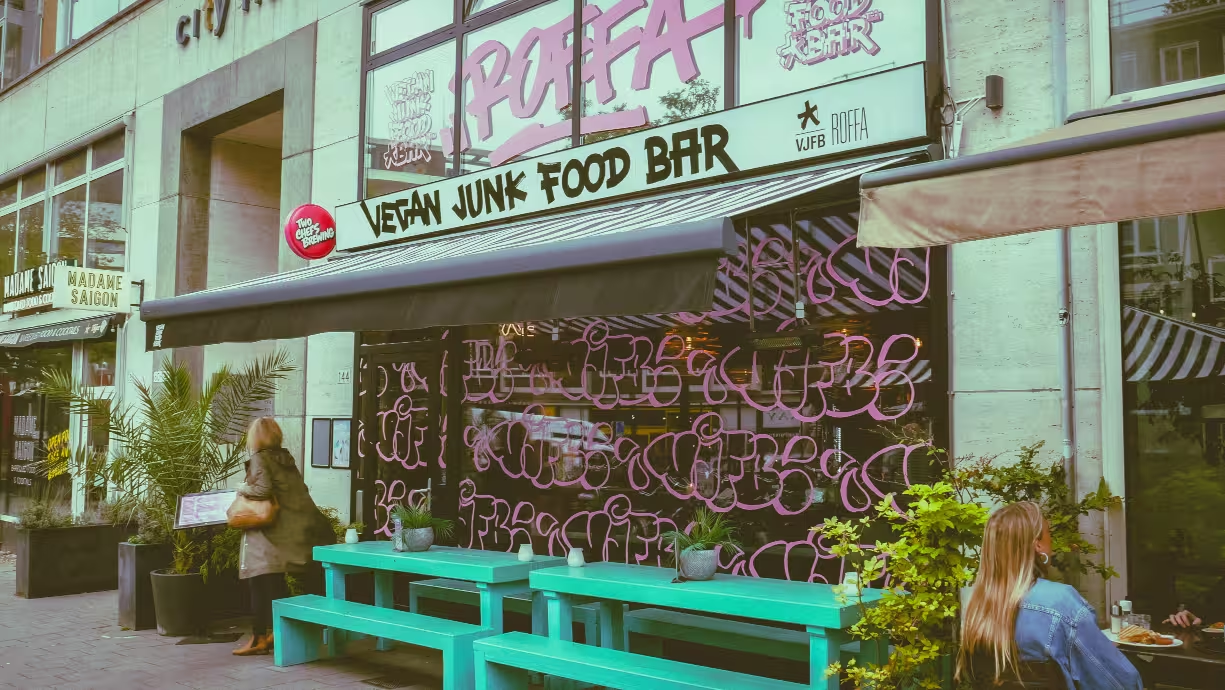
Hybrid cultural projects, like the one developed in the Ménilmontant by Covivio building, clearly demonstrate this logic. By integrating artistic and event-based dimensions into temporary occupancy, these initiatives contribute to the symbolic re-imagining of these spaces. The pop-up restaurant is then part of a broader programming approach.
Finally, these formats enable us to test innovative concepts at low risk :
- Sustainable or committed food service,
- Hybrid formats (food + culture, food + retail),
- New customer experiences.
For the landlord, this serves as a real-life laboratory, capable of guiding future operational choices.
A new generation of pop-up restaurants at the intersection of culture, lifestyle, and real estate
The pop-up restaurant is no longer limited to a simple food service offering. It is now part of a broader trend of asset transformation into hybrid living spaces.
In iconic settings like the Tuileries Garden, the installation of temporary restaurants high-end shows how food can become a central element of a broader experience, blending heritage, lifestyle, and events.
This evolution is based on a key idea: the place should no longer just be functional; it must be desirable. The pop-up restaurant contributes to this desirability by:
- Creating unique experiences,
- Attracting specific communities,
- Enhancing the venue's image.
It becomes a storytelling tool, capable of transforming an asset into a destination.
Structuring a sustainable real estate activation strategy through pop-up restaurants
While pop-up restaurants are powerful levers, their effectiveness depends on their integration into an overall strategy.
An isolated pop-up can generate one-off traffic, but without continuity, the impact remains limited. To maximize real estate value, several elements must be in place :
- A consistent program over time,
- A relevant selection of hosted concepts,
- Integration with the other uses of the location.
Understanding and leveraging pop-up restaurants as real estate activation tools
Today, the pop-up restaurant has become much more than a food trend. It is a full-fledged real estate activation tool, capable of simultaneously address the needs of both brands and landlords.
For brands, it offers a powerful way to connect and become part of consumers' daily lives. For landlords, it allows them to revitalize vacant spaces, generate foot traffic, and test new concepts.
At the intersection of marketing, experience, and real estate, the pop-up restaurant is firmly established in asset transformation strategies. When thoughtfully planned, it becomes a true value accelerator, far beyond its temporary nature.
Tomorrow Food operates precisely within this intersection of food, experience, and real estate. With a keen understanding of industry dynamics, we support stakeholders in implementing relevant activation strategies, taking into account:
- Consumer expectations,
- Operational constraints,
- The challenges of asset enhancement.
The goal isn't just to set up a pop-up restaurant, but to design an experience consistent with the location, brand, and its environment. This approach allows us to transform a simple pop-up into a true strategic lever, capable of:
- Enhancing a site's appeal,
- Creating perceived value,
- Supporting real estate transformations.
Contact Tomorrow Food now to structure your temporary restaurants and revitalize both your assets and your brands.