Wellness is now establishing itself as one of the most significant drivers of transformation in the F&B sector. Long confined to a few niches (healthy food, detox, vegan), it is now profoundly redefining consumer expectations, the design of offerings, and the very role of F&B in living spaces.
This movement is no longer a passing trend. It reflects a lasting evolution: eating is no longer enough; the experience must also nourish the body, mind, and lifestyle.
How is wellness transforming the F&B sector?
Three major dynamics help us understand how wellness is concretely transforming F&B.
Functional food is becoming the new everyday norm
The first strong signal of F&B wellness is the rise of functional food.
The objective is no longer merely to eat, but to meet specific needs: energy, immunity, concentration, recovery.
What's profoundly changing is that this approach is moving out of specialized channels and into everyday life.. The best example remains coffee, the universal product par excellence, which is evolving towards:
- enriched recipes (adaptogens, collagen, superfoods),
- functional benefits (focus, relaxation, performance),
- a redesigned experience focused on wellness.
In Paris, places like DAYZ perfectly illustrate this transformation: you no longer simply consume a drink there, but a wellness routine integrated into a moment of their day.
Coffee thus becomes an accessible entry point to wellness, and more broadly, the symbol of an F&B that is integrated into daily routines rather than being reserved for special occasions.
Fast good redefines fast food standards
Second major transformation: the rise of fast good.
Unlike traditional fast food, this model is based on a clear promise: speed, without compromising on quality or nutritional balance.
Wellness F&B is significantly boosting this trend, by imposing new standards:
- whole ingredients, fresh, often local
- transparency regarding ingredients
- balanced recipes and clear
- tailored offerings to new dietary needs
This model addresses a key expectation: to eat healthily despite a busy schedule, without sacrificing practicality.
But beyond the product offering, the 'fast good' trend reflects a deeper shift: consumer expectations are rising, even for quick formats. 'Fast' is no longer an excuse for a subpar experience.
Instead, it's becoming a fertile ground for innovation to reconcile:
- quality,
- efficiency,
- desirability.
Social clubs blend F&B, lifestyle, and belonging
A third foundational trend: the rise of social clubs.
Players like Soho House embody this evolution where F&B is no longer just a dining option, but a central element of a social ecosystem. In these venues:
- people come as much to see and be seen as to consume,
- the programming (events, meetings, culture) is as important as the menu,
- F&B becomes a medium for experience and social interaction.
Wellness F&B fully integrates into this logic:
- menus designed to accompany different moments of the day,
- offerings adapted to hybrid uses (work, relaxation, networking),
- attention paid to the atmosphere, the rhythm, the energy of the place.
The meal becomes a pretext for a collective experience, and no longer an end in itself. This evolution reveals an interesting tension: between elitism (private clubs, selection) and desire for accessibility (club aesthetics replicated in more open venues).
Wellness is giving rise to more demanding, informed, and volatile F&B consumers
These three trends reflect a broader transformation: the consumer is changing, and with them, the level of F&B expectations. Today, expectations are compounding:
- eating well,
- understanding what they consume,
- having a consistent experience,
- identifying with the venue's values.
F&B wellness amplifies this phenomenon by introducing new criteria:
- health impact,
- environmental impact,
- consistency between rhetoric and reality.
Weak or poorly positioned concepts quickly become invisible
The choice is no longer based solely on price or location but on the overall relevance of the experience offered.

Wellness positioning becomes central to the success of an F&B concept
In this context, wellness acts as a strategic revealer. It compels actors to clarify their promise, their target audience, and their role in customers' daily lives.
A place can no longer be "generalist." It must serve a clear purpose:
- routine spot wellness
- social space hybrid
- quality fast food
- lifestyle destination
F&B becomes a storytelling and differentiation tool, positioning directly impacts:
- the offer design,
- the design of the space,
- the programming,
- communication.
Wellness F&B becomes a driver for asset differentiation
This is arguably the most defining aspect, particularly in hospitality and hybrid venues: F&B is no longer an ancillary service, it becomes a strategic lever for asset enhancement :
- attract local clientele (and not just captive)
- generate traffic regularly
- create a strong identity
In a wellness context: F&B provides a reason to visit, return, and stay. It contributes to the overall quality perception, brand image, and desirability of the venue.
Wellness profoundly transforms the F&B sector:
- it shifts food from a basic need to a strategic function of well-being,
- it elevates the standards, including the most accessible formats,
- it merges dining, experience, and social interaction,
- it establishes a clear positioning and differentiating.
More than a trend, wellness F&B is becoming a new framework for understanding the industry.
Players who can integrate it will not only offer a relevant proposition.
They will build places capable of becoming a lasting part of their customers' lives.
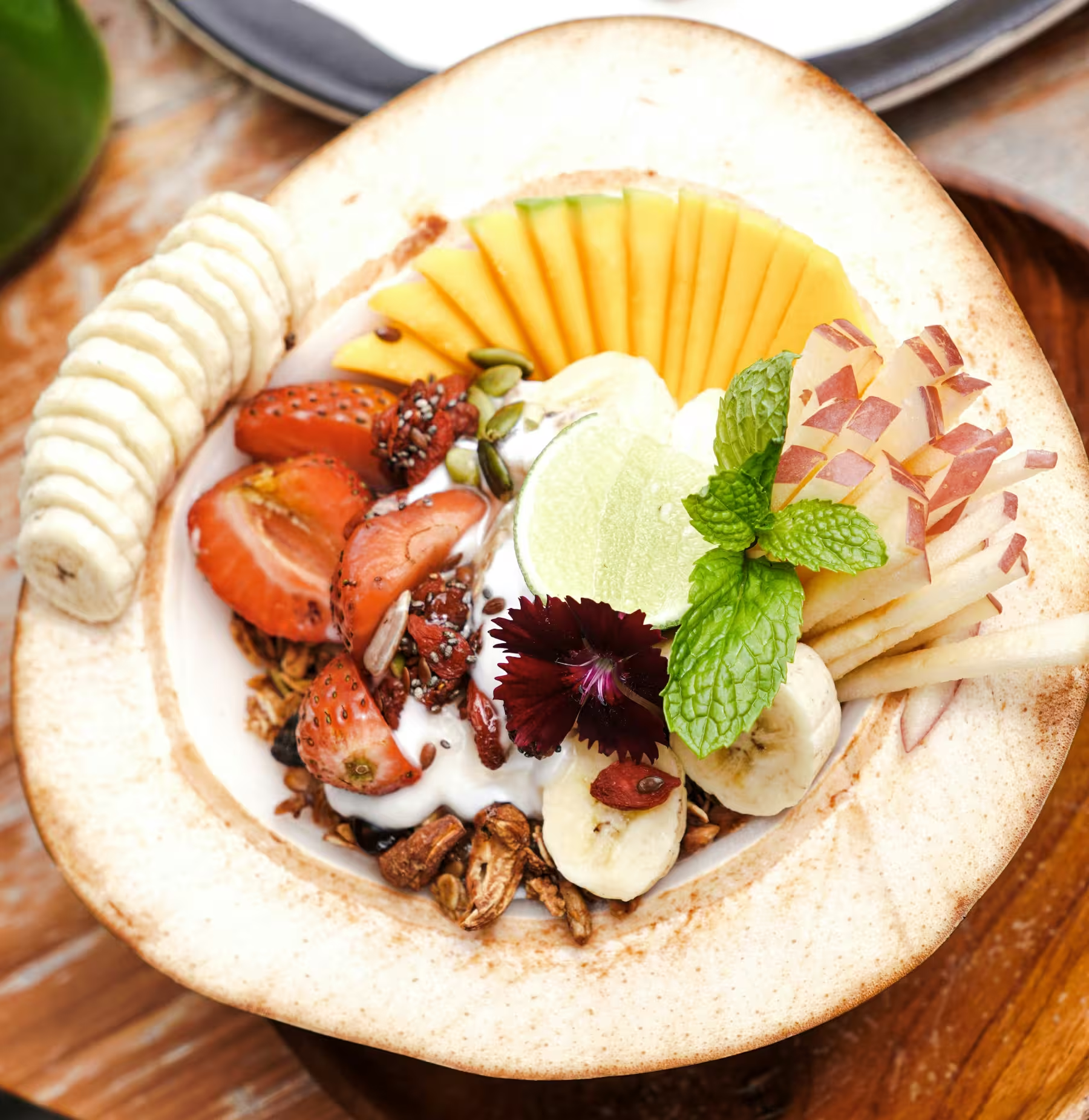
Tomorrow Food: aligns wellness and F&B to create an experience that meets real needs
Given these changes, conceiving a high-performing F&B offering is no longer just about defining a menu, but also to understand actual usage patterns of customers, articulate consumption moments and to create a cohesive experience across the entire venue.
This is precisely Tomorrow Food's role: to support the design of F&B concepts aligned with contemporary expectations, by:
- the definition of a positioning clear,
- the structuring of the programming (highlights, rhythms, usage patterns),
- the creation of holistic experiences, beyond the plate.
Wellness F&B is redefining standards, performance no longer relies solely on what is served, but on how the venue is experienced.
Get in touch with Tomorrow Food to create a coherent and attractive wellness F&B offering, aligned with consumers' desires and needs.